Avigdor Arikha (1929-2010) moved from Israel to Paris in 1949, where he became an integral part of the artistic and intellectual life of the city until his death on 29 April 2010. A painter, draughtsman, printmaker and art historian, he is known for working only in natural light and for producing each of his works in one day.
Born into a German-speaking Jewish family in Bukowina, Arikha was deported, in 1941, to a Transnistrian concentration camp, where his father died. He survived thanks to sketches he composed on scraps of paper, depicting the horrors of the Holocaust. Those were shown to delegates of the Red Cross, who facilitated his and his sister's escape.
In 1944, at the age of fifteen, Arikha moved to the British Mandate of Palestine. Schooled in Jerusalem mostly by Bauhaus teachers who had escaped Germany, Arikha adopted a modernist approach, mastering multiple skills and mediums in line with Bauhaus principles.
He moved to Paris to attend the École des Beaux-Arts, eventually becoming a prominent figure in Parisian intellectual and artistic circles, with close friends including Samuel Beckett, among others.
Throughout the eighties and nineties Arikha also rose to prominence as an art historian, lecturing around the world. He curated exhibitions internationally, including Ingres at the Frick Collection, New York and Poussin at the Louvre, Paris. In 1992 he was commissioned by The BBC to make a documentary about Velazquez.
Arikha's work is in public collections worldwide including: British Museum, London, UK; Denver Art Museum, Denver, US; Galleria degli Uffizi, Florence, IT; Hirshhorn Museum and Sculpture Garden, Washington, D.C., US; Israel Museum, Jerusalem, ISR; The Jewish Museum, New York, US; The Metropolitan Museum of Art, New York, US; Musée des Beaux-Arts, Dijon, FR; Musée du Louvre, Paris, FR; Musée National d'Art Moderne, Centre Pompidou, Paris, FR; National Portrait Gallery, London, UK; Scottish National Portrait Gallery, Edinburgh, UK; Tate, London, UK.
He was awarded many prizes and honorary degrees, and named a Chevalier de la Légion d'Honneur in 2005.
 Sold
Sold
LOT 4
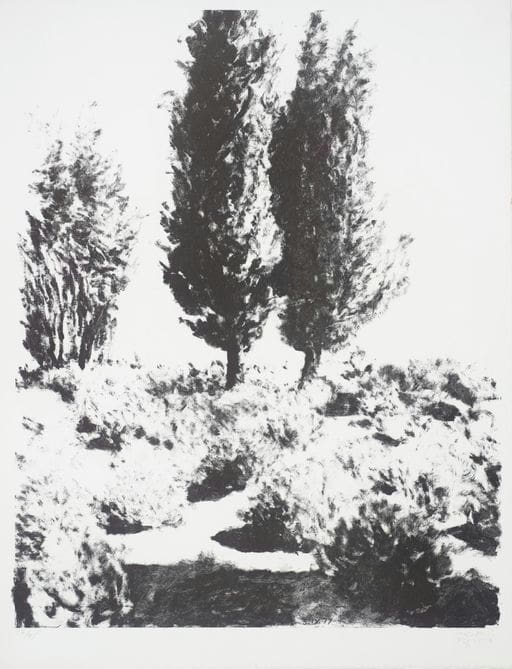
Avigdor Arikha
Jerusalem Cypresses and Lavender
USD 750
Log in to save artworks to your favorites.