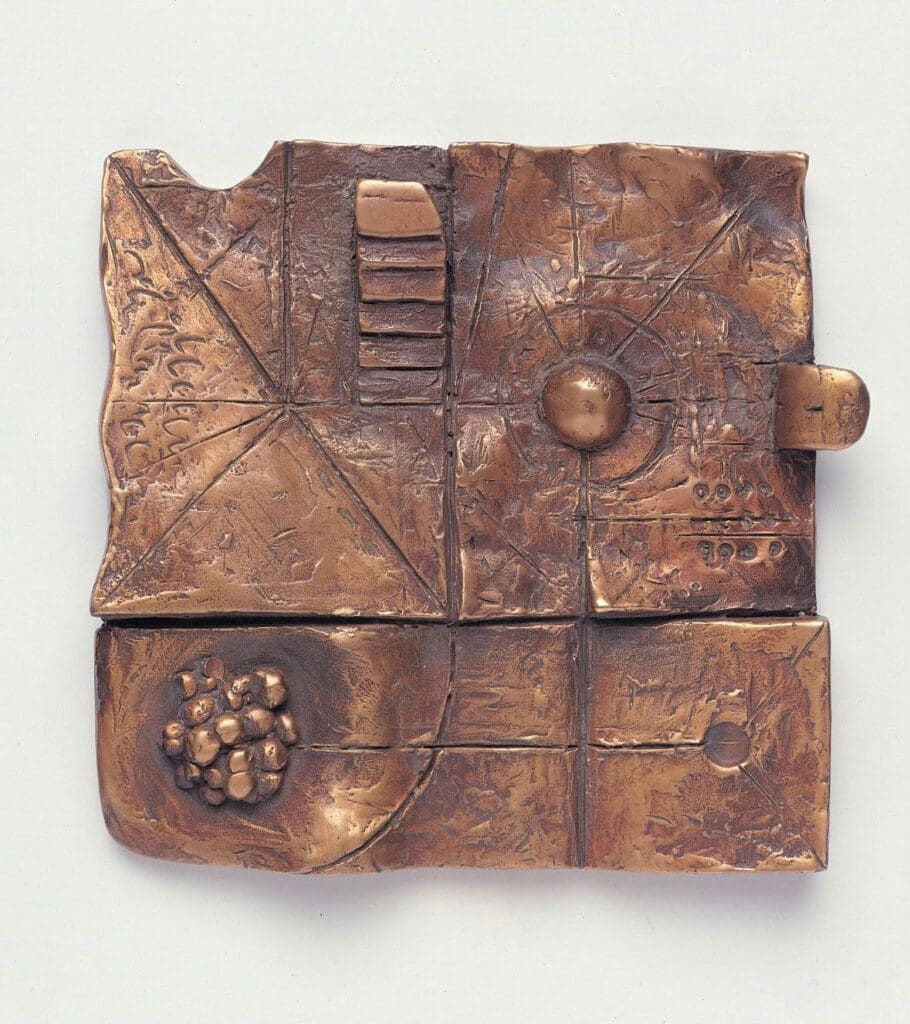
LOT 53
| Technique | Sculpture |
| Size | 2 x 11 cm |
| Availability | Sold |
| Donation | 100% |
| Pickup | Zvi Hermann Shapira 19, Tel Aviv, 1st floor, appt 2 |
Final model for a large bronze wall relief for Jerusalem Hilton Hotel, as part of an environmental sculpture set in the hotel's lobby. Part of the sculpture is still visible at Vert Hotel, Jerusalem
About Dani Karavan
Dani Karavan (1930–2021)
Dani Karavan was born in Tel Aviv to Zehava and Abraham Karavan, who later became the city's landscape architect.
He studied painting with leading artists including Aharon Avni, Avigdor Steimatzky, Yehezkel Streichman, Marcel Janco, and Mordechai Ardon.
In 1948, he was among the founders of Kibbutz Har'el, where he met his wife, Hava.
During this period, he produced politically engaged drawings and paintings.
In 1956, Karavan travelled to Florence to study fresco at the Accademia delle Belle Arti, where the foundations of his interdisciplinary artistic practice were established.
Upon returning to Israel, he created set designs for the Cameri Theatre, the Inbal Dance Company, the Martha Graham Dance Company in New York, and the Batsheva Dance Company, of which he was a founding member.
During the 1960s, Karavan created his first site-specific public works, including concrete and stone reliefs for the Tel Aviv Court of Justice, the Weizmann Institute of Science, and the Negev Monument in Beersheba.
Karavan's major environmental works include: Kikar Levana (White Square), Tel Aviv (1977–1988); Axe Majeur, Cergy-Pontoise, France (1980–2012); Ma'alot, Cologne, Germany (1979–1986); Passage, Nuremberg, Germany (1995–2000); Mamshit Negev, the Egyptian border (1996–2000); Murou Art Forest, Murou, Nara, Japan (1998–2006); Homage to the Sinti and Roma, Berlin, Germany (1999–2012); Culture Square, Tel Aviv, Israel (2001–2012).
Karavan exhibited widely in museums around the world, and his works are included in numerous prestigious public and private collections.
He received many major international awards, including the Israel Prize for Art and Science (1977), the Goslar Kaiserring for Visual Art (1996), UNESCO's Artist for Peace designation (1996), the Praemium Imperiale (1998), and the Piepenbrock Award for Sculpture (2004).
He was also among the initiators of efforts to preserve Tel Aviv's International Style (Bauhaus) architectural heritage.
Throughout his life, Karavan was a dedicated advocate for peace and human rights.
Log in to save artworks to your favorites.